GuidesDecision Guide
How Deep Should Mulch Be?
There is no single mulch depth that is right for every bed. Guidance commonly falls in roughly the 2–4 inch range, but material, existing mulch, soil, and planting context matter.
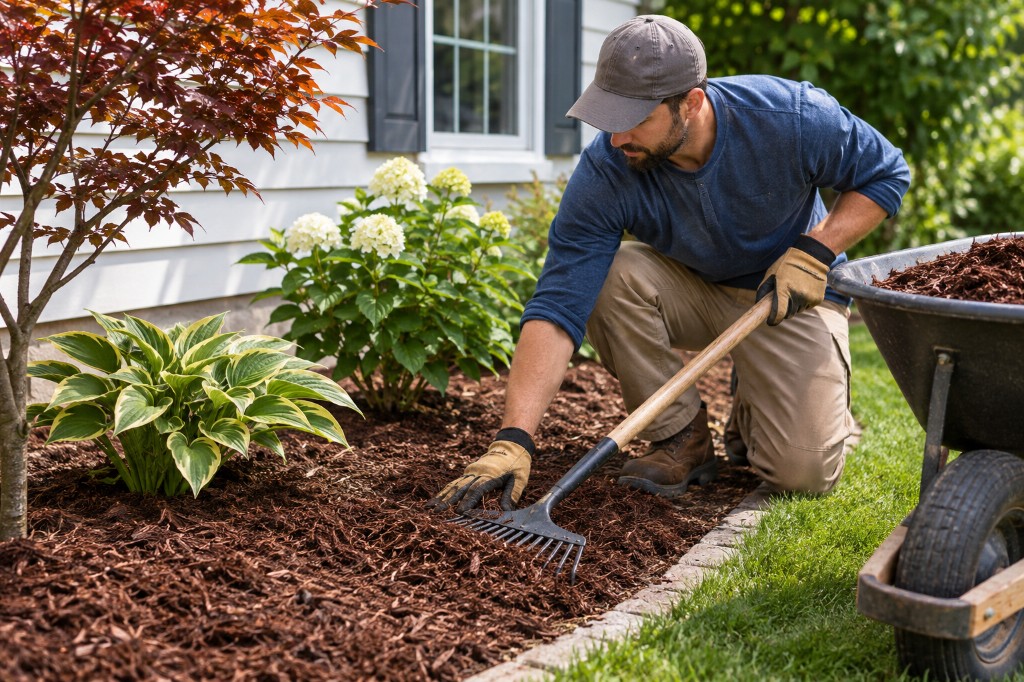
There is no single mulch depth that is right for every bed. Guidance commonly falls in roughly the 2–4 inch range, but the material, existing mulch, soil, and planting context matter.
Adding more mulch is not automatically better. The target depth should account for what is already in the bed.
Why depth varies
Extension and arboricultural sources do not collapse to one prescription:
- University of Illinois Extension discusses about 2–4 inches, with composted materials often in a 2–3 inch band and coarser mulches 3–4 inches
- University of Vermont Extension describes about 2–4 inches in a flat ring, not a mound against bark
- Wisconsin Horticulture notes 2–4 inches, often deeper on light well-drained soils and shallower on heavier clay
- University of Maryland Extension emphasizes keeping mulch shallow (often about 1–3 inches depending on material) and off the trunk
Those are horticultural ranges — planning context, not a FixUpWise rule.
Existing mulch matters
Organic mulch settles and decomposes. Before topping up, check what is already there so you do not stack past a sensible finish depth. The Mulch Calculator estimates quantity for the depth you enter; it does not choose that depth for you.
Trees, shrubs, and open beds
Tree and shrub mulching often uses the same rough depth band as open beds, but placement matters as much as thickness. Annual beds, vegetable rows, and woody plantings can call for different materials and finish depths even when the inch figure looks similar on paper.
Why too much can be a problem
Excess depth can hold too much moisture against bark, reduce oxygen exchange near roots, and make it harder to see the root flare. “More mulch” is not a universal upgrade.
Keep mulch away from trunks and stems
Pull mulch back so the trunk or root flare is visible. This page is depth and quantity planning — not tree diagnosis or treatment.
Depth → coverage comparison
Deeper mulch covers less area per cubic yard:
| Depth | Coverage per yd³ |
|---|---|
| 2 in | 162 sq ft |
| 3 in | 108 sq ft |
| 4 in | 81 sq ft |
Same 100 sq ft bed: about 0.62 yd³ at 2 in, 0.93 yd³ at 3 in, 1.23 yd³ at 4 in. Full coverage table: how much area a yard covers. Volume formula: how much mulch do I need?.
Decision checklist
| Situation | What to check |
|---|---|
| Existing mulch already present | Remaining depth before adding more |
| Coarse vs fine material | Guidance often shifts within the 2–4 in band |
| Heavy / poorly drained soil | Sources often favor the shallower end |
| Trees and shrubs | Depth plus clearance from trunk / stem |
| Quantity shopping | Convert chosen depth to yards or bags in the calculator |
Related reading
Sources
- University of Illinois Extension — Proper Mulching Techniques — University of Illinois ExtensionRecommended mulch depth 2–4 inches; keep mulch away from the trunk
- University of Vermont Extension — Beware the Mulch Volcano — University of Vermont ExtensionApply about 2–4 inches deep; keep mulch off the trunk/root flare
- Wisconsin Horticulture — Wood Mulch and Tree Health — University of Wisconsin ExtensionOften 2–4 inches depending on soil; keep mulch off the trunk
- University of Maryland Extension — Mulching Trees and Shrubs — University of Maryland ExtensionMaterial-dependent shallow depths; keep mulch about 3 inches from trunks
- Virginia Cooperative Extension — Mulching for a Healthy Landscape (426-724) — Virginia Cooperative ExtensionLandscape mulching depth and trunk clearance context
- ISA / TreesAreGood — Proper Mulching Techniques — International Society of ArboricultureRecommended depth ranges; avoid mulch volcanoes