GuidesDecision Guide
How Much Extra Tile Should You Buy?
There is no single extra-tile percentage for every job. Around 10% is commonly suggested for straightforward layouts; diagonal or cut-heavy work is often planned closer to 15%.
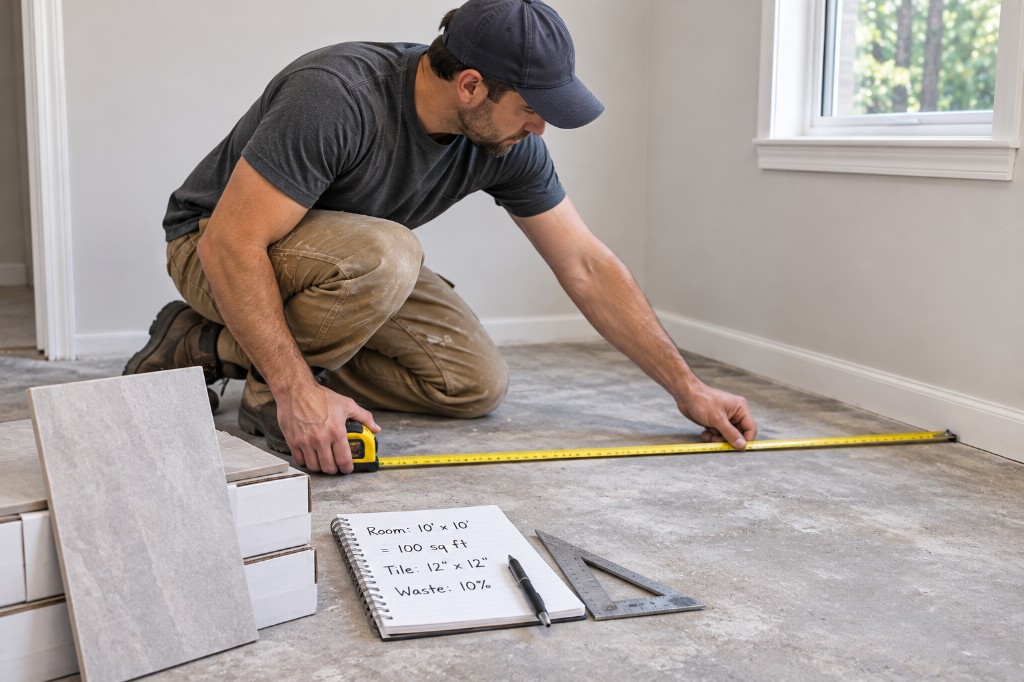
There is no single extra-tile percentage that fits every installation. Around 10% is commonly suggested for straightforward layouts, while diagonal or more cut-heavy work is often planned closer to 15%, but product, layout, room shape, and future-repair needs can change the answer.
An editable allowance is more useful than automatically adding the same percentage to every tile job. That is how the FixUpWise Tile Calculator is built: Straight → 10%, Diagonal → 15%, or Custom.
Why extra tile is purchased
- Perimeter and obstacle cuts
- Breakage while cutting or handling
- Layout inefficiency (offcuts that do not reuse well)
- Matching material later (“attic stock”)
Straight / simple layouts
Supplier planning discussions often start near 10% for standard straight or simple offset work (Clé, Bedrosians, Merola). That is a planning band, not a guarantee for every room.
Diagonal / more cut-heavy layouts
Clé and Bedrosians discuss about 15% for diagonal or more intricate patterns. Merola notes about 15% when rooms have many jogs and corners. Angled perimeter cuts create more unused triangles — one reason the calculator suggests a higher default for diagonal.
Complex patterns and irregular rooms
Herringbone, many niches, or elaborate patterns can need still more. Merola points to installer judgment for elaborate work. Bedrosians notes higher overage for complex patterns beyond a simple diagonal.
Spare tile for future repairs
Daltile discusses purchasing about 10% more as attic stock for repairs and dye-lot matching. Do not automatically stack a second attic-stock percentage on top of the calculator waste field. If your supplier separates layout waste from attic stock, choose one combined percentage that matches how you intend to order.
These are supplier planning discussions — not a free TCNA universal waste table.
Decision checklist
| Situation | What to check |
|---|---|
| Straight / simple rectangle | Common ~10% planning band |
| Diagonal layout | Common ~15% planning band |
| Many jogs / irregular room | Higher allowance; product/installer guidance |
| Complex pattern (e.g. herringbone) | Often above the simple diagonal band |
| Future dye-lot matching | Spares from the same order |
tiles to buy = ceil(rawExact × (1 + waste%))
Example: 100 raw tiles → 110 at 10%, 115 at 15%. Same footprint examples: how much tile for a 10×10 room. Formula: how much tile do I need?.
Related reading
Sources
- Clé Tile — How much extra tile to buy — Clé TileRoughly 10% for standard layouts; about 15% for intricate or diagonal layouts
- Bedrosians — How to plan a tile layout — BedrosiansAbout 10% straight/offset; about 15% diagonal; higher for herringbone and complex patterns
- Merola Tile FAQ — Merola TileAbout 10% for most standard installs; about 15% when many jogs/corners; consult installer for elaborate patterns
- Daltile FAQ — Attic stock — DaltileRecommends purchasing approximately 10% more for attic stock / future repairs and dye-lot matching